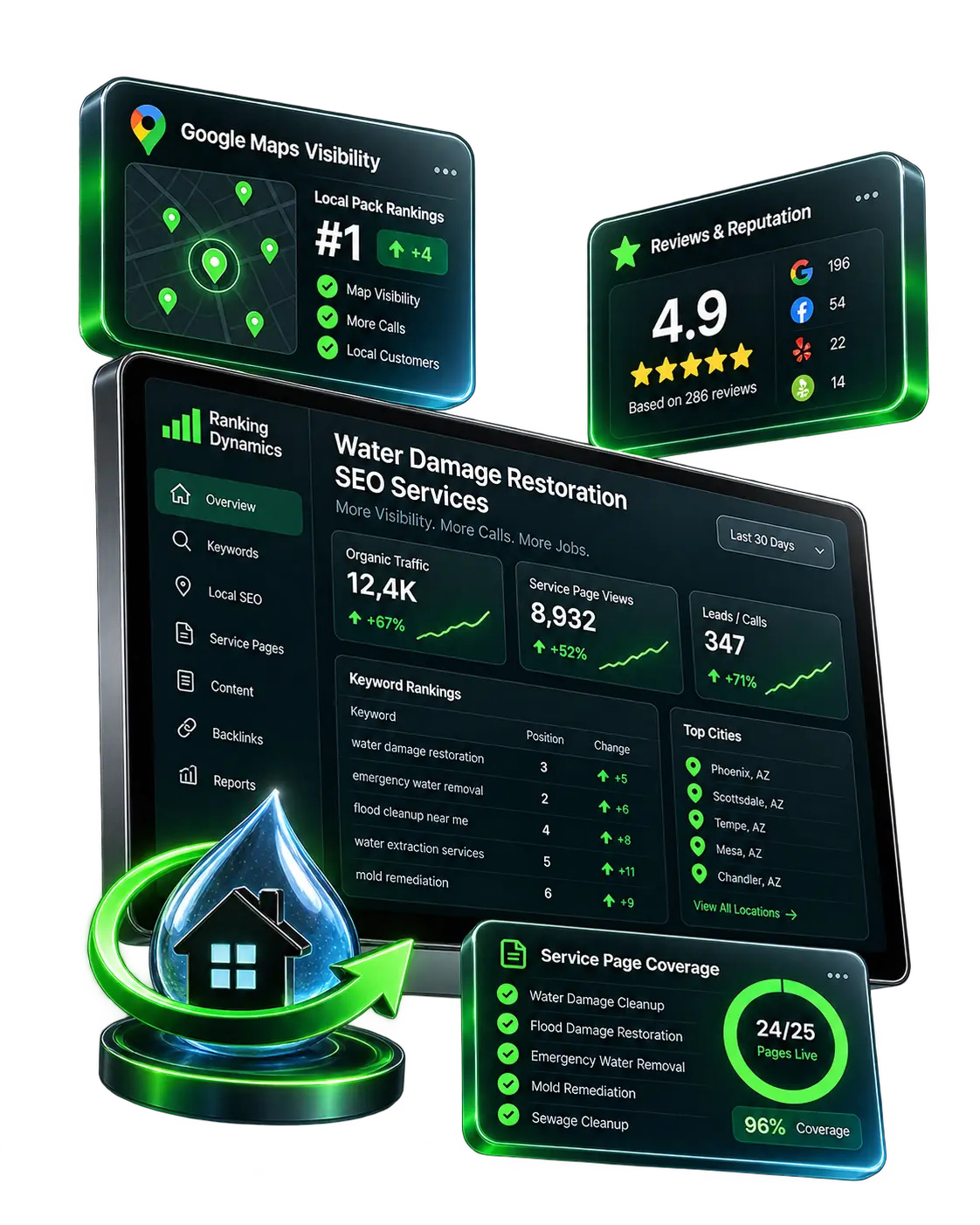
Water Damage Restoration SEO Services


 We build the Google Maps, organic search, service-page and local authority system that helps restoration companies get found before the call goes somewhere else.


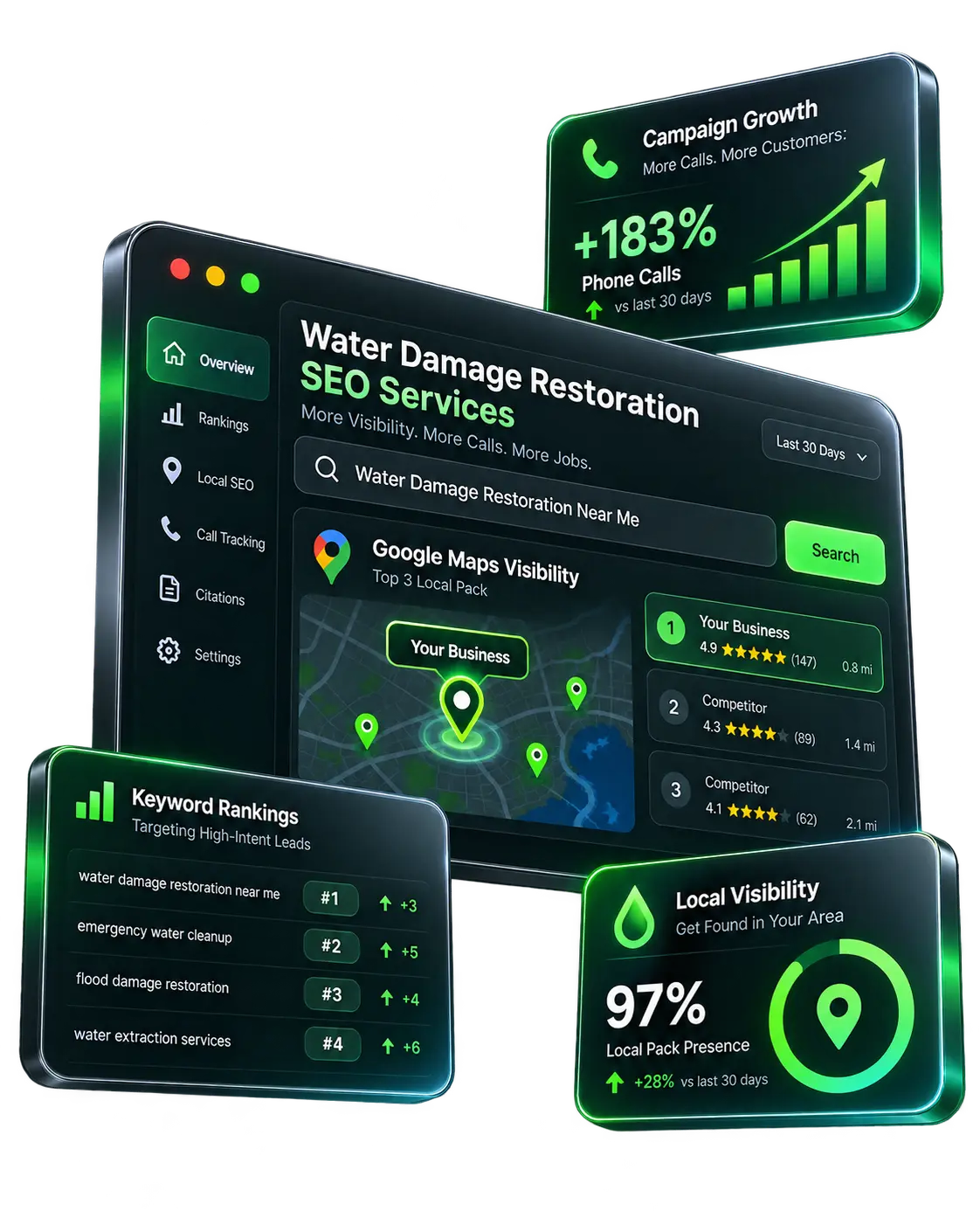
Water Damage SEO Starts When the Emergency Search Begins
A homeowner dealing with a burst pipe or flooded room usually does not begin with a long research process. They search from a phone, look for an available restoration company nearby and make contact quickly.
That makes visibility only one part of the job. Your Google profile, service relevance, reviews, website and contact path all have to support the decision.
Water damage restoration SEO therefore has to connect Maps, organic search, service pages, local trust and conversion tracking around the same emergency journey.
The exact journey varies from customer to customer. What matters is that restoration demand can move from problem to search to call very quickly.
What Is Water Damage Restoration SEO?
Water damage restoration SEO is the process of improving a restoration company's visibility across Google Maps and organic search for the services and locations customers use when they need immediate help.
It connects technical SEO, Google Business Profile optimization, service and location pages, content, local authority and lead measurement into one search system.
Google Maps
Compete where urgent local restoration searches often begin.
Local VisibilityOrganic Search
Own service, emergency and location search intent beyond the local pack.
Search CoverageWebsite Architecture
Give important services, locations and supporting topics the right destination.
Page OwnershipAuthority
Strengthen the trust and external signals supporting local and organic visibility.
Trust SignalsDamage Happens
Flooding, a burst pipe, sewage backup or another water-loss event creates immediate demand.
They Search
Customers use service terms, near-me searches and location-specific restoration queries.
You Appear
Google Maps and organic search decide which companies become visible during the search.
They Verify
Reviews, service relevance, real-world proof and website trust help customers decide who to contact.
They Call
Search visibility becomes valuable when the path from result to contact produces a qualified restoration lead.
We are not optimizing one keyword or one Google Business Profile in isolation. We are building the search system around the moment a customer needs restoration help — from local visibility and service relevance to trust, website experience and the final call.
Why SEO for Water Damage Restoration Works Differently
Restoration combines emergency intent, service-specific searches, wide service areas and high-value opportunities. That changes what an SEO campaign has to prioritize.
Emergency Intent
Search demand can appear immediately after a loss. Visibility needs to exist before the emergency happens, not after the business decides it wants more leads.
Service Specific Search
Water extraction, flood cleanup, sewage cleanup and emergency water removal are related services, but they can represent different search intent and different pages.
Service Area Competition
A restoration company can perform strongly close to its location and become much less visible farther across the service area. One ranking position cannot describe that.
High Value Calls
Restoration SEO does not need to chase every possible visitor. A smaller number of qualified calls around the right services and markets may matter far more commercially.
SEO should strengthen the channel it can influence — not pretend it replaces everything else.
Restoration companies can grow through several acquisition channels. Our role is to understand which signals SEO can directly improve, which it can support, and which remain separate.
Google Maps + Search
High-intent local demand that SEO can directly influence through visibility, relevance, website coverage and authority.
Vendor + Insurance Networks
SEO does not create the relationship, but accurate business information, trade proof and a credible website can support how the company is evaluated.
Referral Partners
Plumbers, property managers and existing professional relationships remain their own acquisition engine. Search visibility should complement them, not replace them.
Paid / Bought Leads
Paid search and third-party lead sources can generate demand, but they operate separately from the organic visibility assets the business builds and keeps.
The restoration SEO strategy should create an owned source of local demand while strengthening the credibility customers, partners and other acquisition channels see when they check the company online.
Our Water Damage Restoration SEO Services
Instead of treating SEO as a list of disconnected monthly tasks, we organize the campaign around three business outcomes — then support them with technical, content, authority and measurement work underneath.
Win More Local Search Visibility
Strengthen the Google Business Profile and the local signals that influence whether the company appears across the service area when urgent restoration demand starts.
- Google Maps and GBP optimization
- Reviews, photos, services and profile relevance
- Local citations and business-data consistency
- Geo-grid visibility measurement
Build the Pages Search Demand Needs
Turn services, emergency intent and priority markets into a clear website architecture instead of forcing every keyword onto one generic restoration page.
- Service page SEO
- Location and service-area architecture
- Internal linking and crawl paths
- Supporting topical content
Build Authority and Measure the Calls
Strengthen the signals beyond the page, then connect search visibility to the calls and forms the restoration company can actually evaluate as business opportunities.
- Relevant links and brand mentions
- Trade and local authority sources
- Call and form tracking
- Performance reporting by service and market
Hover any module to see which primary growth lever it supports.
Technical SEO
Crawlability, indexing, speed, schema and technical page health.
Supports Lever 02Content SEO
Guides, FAQs and topical content supporting commercial restoration pages.
Supports Lever 02Conversion Path
Calls, forms, mobile usability and friction between search and contact.
Supports Lever 03Competitor Gaps
Compare services, markets, authority and visibility against competing restoration companies.
Supports Lever 03Google Maps
Profile optimization, reviews, services and geographic visibility coverage.
Supports Lever 01Service Pages
Water damage, flood cleanup, sewage, extraction and related high-intent services.
Supports Lever 02Location SEO
Priority cities, real service areas and local search coverage opportunities.
Supports Lever 01Lead Tracking
Track source, service, location, call activity and form performance.
Supports Lever 03Maps, technical SEO, content, service pages, links and tracking only become valuable when they support the same commercial objective — making the restoration company easier to find, easier to trust and easier to contact.
We Build Around the Searches That Turn Into Restoration Jobs
Different search intent deserves different destinations. The goal is not to force every keyword onto one page. It is to understand what the customer is looking for and build the right page for each meaningful search journey.
Example architecture only. Final keywords, pages and markets depend on real search-demand and competitor research.
Core Service Searches
Emergency Intent
Location Intent
The Website Architecture Behind Restoration SEO Growth
We connect the main restoration offer to focused service pages, priority markets and supporting content so users and search engines can understand what the company does, where it operates and which page best answers each search.
Strong restoration SEO connects the two. We map search intent first, assign the right destination second, then use internal links, technical SEO and supporting content to make the whole structure work as one system.
Google Maps SEO for Water Damage Restoration Companies
A restoration company can be visible close to its location and much weaker elsewhere across its service area. We treat Google Maps visibility as a geographic coverage problem that can be measured, improved and tracked over time.
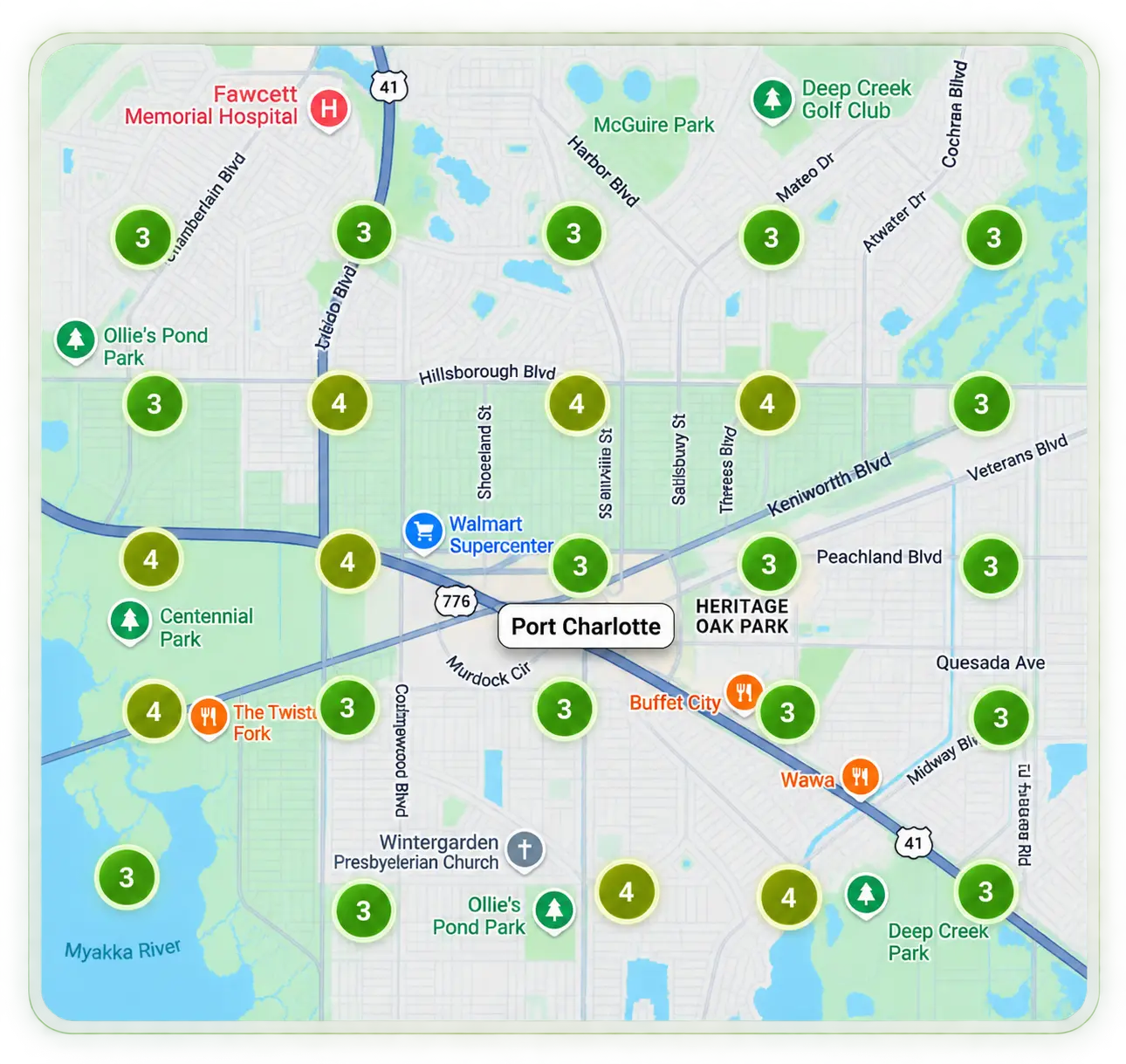
Geo-grid tracking gives us a more useful view of local visibility than relying on one manually checked ranking from one location.
Profile Relevance
Align categories, services, business information, service details and supporting profile content with the company's real restoration offering.
Review Strength
Build a steady, authentic review process that supports customer trust and strengthens the profile without manufacturing signals.
Local Authority
Strengthen citations, relevant local mentions and consistent business information that reinforce the real company behind the Google Business Profile.
Coverage Measurement
Use geo-grid tracking to understand where visibility is strongest, where it weakens and which parts of the service area need further investigation.
Local SEO decisions become more useful when we can see where the restoration company is already competitive, where visibility falls away and which areas deserve attention based on actual business priorities.
Technical SEO Built for Emergency Search
A strong restoration company still needs a website Google can crawl, render, understand and index correctly. Technical SEO keeps service pages, location pages and supporting content accessible while reducing friction for customers searching from a phone during an urgent situation.
Crawl
Search engines need a clear route to important restoration service pages, location pages and supporting content.
Render
Critical page content needs to load correctly and remain usable for both search engines and customers searching during an active emergency.
Index
The right commercial pages need to remain eligible for search while duplicate, obsolete or unwanted URLs stay under control.
Understand
Page structure, entities and appropriate structured data help search engines understand the business, services and relationships between pages.
Connect
Internal links connect restoration services, priority locations and supporting content so relevance and authority are not trapped on isolated pages.
Crawl and Indexation
Make sure important restoration service pages, location pages and supporting content can be discovered, crawled and indexed without unnecessary technical barriers.
Mobile Performance
Reduce friction for customers searching during an active water emergency, especially where slow loading or difficult mobile contact paths can cost qualified opportunities.
Schema and Entities
Use structured data where appropriate to clarify the business, services, breadcrumbs and page relationships without treating schema as a substitute for real relevance.
Internal Linking
Connect services, priority markets and supporting information through contextual internal links so relevance and authority do not remain isolated on individual pages.
Exact priorities depend on the website platform, architecture, history and current search performance.
Bots, crawl paths, blocked URLs and discoverability.
Canonicals, noindex signals, duplicates and page eligibility.
Loading behavior, interaction and visual stability.
Relevant markup, validation and entity relationships.
Service depth, location paths and orphan-page risks.
Broken destinations, redirect chains and legacy URLs.
The goal is not to collect technical fixes for a report. It is to remove the issues that prevent important restoration pages from being discovered, understood, ranked and converted into real customer actions.
Content SEO for Water Damage Restoration Companies
The main service page should not answer every possible question on its own. Supporting content helps water damage restoration companies rank across the research journey, capture long-tail demand, and strengthen the service and location pages it links back to.
Insurance and Cost Questions
Build content around the questions homeowners ask before they decide who to call, what insurance may cover, what affects cost, and what to do first after water damage.
Emergency Water Damage Guides
Capture urgent informational searches around burst pipes, flooding, sewage backups, emergency water removal, and first-response steps users search before or during a crisis.
Drying Timelines and Process
Explain water extraction, drying, mitigation, restoration steps, and realistic timelines so the website covers process-based searches while building trust with potential customers.
Common Home Water Damage Problems
Build articles around basement flooding, ceiling leaks, appliance failures, bathroom overflows, storm-related issues, and other property problems that generate real demand.
Commercial Water Damage Content
Create a separate knowledge path for property managers, facility teams, offices, retail spaces, and commercial losses so commercial intent is not buried under residential content only.
Internal Link Support
Every useful article should strengthen the right service or location destination. Supporting content should guide users and authority back to commercial pages, not live in isolation.
Helpful content should support rankings, not distract from the main offer.
The purpose of content SEO here is not to publish random blogs every month. It is to build topic clusters around real water damage restoration searches, then connect those articles to the core service pages, sub-service pages, and priority location pages that need stronger ranking signals.
Backlink Building and Local Citation Building for Water Damage Restoration Companies
Search visibility is not built by on-page optimization alone. We strengthen relevant backlinks, local citations, reviews and real business signals that help search engines and customers understand who the company is, what it does and where it operates.
Relevant Backlink Building
Earn links and legitimate brand mentions from sources that make sense for the restoration trade, local market and services instead of chasing links purely for volume.
Local Citation Building
Build and clean up listings across useful directories, niche platforms and local sources while keeping the business name, address, phone and website information consistent.
Review and Reputation Signals
Strengthen authentic review acquisition and response processes that support trust, profile quality and customer decision-making across important locations.
Real World Business Proof
Reinforce authority with genuine project evidence, certifications, team information, service photos, case studies and other verifiable business assets.
Restoration companies have authority sources generic campaigns can miss.
Backlink and citation building should reflect the real business. Where a company genuinely qualifies, restoration associations, certification ecosystems, vendor profiles, insurer relationships and local industry sources can add stronger context than another generic directory listing.
IICRC Certification and Locator Opportunities
Where the company genuinely holds the relevant certification or status, accurate business references and locator visibility may reinforce legitimacy and trade relevance.
Eligibility RequiredRestoration Industry Association
Industry membership and directory opportunities can add relevant business context when the restoration company genuinely qualifies and participates.
Membership DependentInsurance and Vendor Profiles
Where legitimate relationships exist, keep company names, phone numbers, websites, locations and business details consistent across partner and vendor systems.
Consistency SignalLocal and Restoration Citation Sources
Build useful local and trade-relevant listings selectively rather than treating citation count as the goal. Relevance, accuracy and legitimacy matter more than bulk submissions.
Quality Over VolumeTrade, geography or business relationship should justify the placement.
Names, phones, URLs and location information should agree across sources.
We prioritize useful placements rather than chasing arbitrary link counts.
Memberships, certifications and partner relationships are verified before use.
For restoration SEO, the strongest off-site strategy combines relevant backlinks, accurate local citations, genuine trade signals, reviews and real-world business proof so the website is supported by an authority footprint that makes sense.
How We Build Your Water Damage Restoration SEO Campaign
We build restoration SEO in connected phases rather than treating technical work, content, Google Maps, authority and measurement as separate tasks. Each stage strengthens the next so the campaign develops into one measurable search growth system.
Audit Search Demand and Competition
Map restoration services, priority markets, current visibility, competitors and the search opportunities worth pursuing first before deciding what pages or campaign work should be prioritized.
Fix the Technical Foundation
Resolve crawl, indexing, architecture, mobile performance, duplication, internal linking and tracking issues that could prevent stronger restoration pages from performing properly.
Build Service and Location Architecture
Create or improve the destinations needed for restoration services, emergency search intent and priority markets so each meaningful search journey has the right landing page.
Strengthen Google Maps Visibility
Optimize the Google Business Profile and reinforce it with accurate local signals, authentic reviews, citations, supporting content and geographic visibility measurement.
Build Content and Authority
Add supporting topical content, relevant backlinks, local citations, industry mentions and internal links around the commercial pages already built to attract and convert demand.
Measure Leads and Expand What Works
Use search visibility, Google Maps coverage, calls, forms, landing-page performance and service-level data to decide which services, locations and content opportunities deserve the next investment.
Research determines the starting point. Technical SEO creates the foundation. Service and location pages capture demand. Google Maps expands local visibility. Content and authority strengthen the system, and measurement tells us where to grow next.
Water Damage Restoration SEO
Questions Before You Start.
No generic SEO answers and no careful half explanations. Open any question to understand how restoration SEO works, what we prioritize and what the strategy means for your business.
What is water damage restoration SEO?
Water damage restoration SEO is the process of improving a restoration company's visibility in Google Search and Google Maps for the services and locations customers use when they need help. It combines technical SEO, Google Business Profile optimization, service and location pages, supporting content, internal linking, citations, backlinks and lead measurement.
The campaign should work as one connected search system, not as a collection of unrelated monthly SEO tasks.
How does Google Maps SEO help a water damage restoration company?
Google Maps SEO strengthens the local signals that help a legitimate restoration company compete across its real service area. That includes Google Business Profile relevance, services, reviews, citations, website relevance, local authority and geographic visibility measurement.
We do not judge local performance from one ranking checked at one address. Geo-grid measurement helps show where visibility is strong and where it weakens.
Should water extraction, flood cleanup and location searches have separate pages?
Often, yes, when search demand and intent justify separate destinations. Water extraction, flood cleanup, sewage cleanup, emergency restoration and city-specific searches can represent different journeys. We research demand first rather than creating thin pages for every keyword variation.
Your website architecture should reflect real services and valuable markets while avoiding duplicate or doorway-style pages.
What content should a water damage restoration company publish?
Useful restoration content can cover insurance and cost questions, emergency response, burst pipes, flooding, sewage backups, drying timelines, restoration processes, property problems and commercial losses. The topics should come from real search demand rather than a generic blogging calendar.
Every useful supporting article should strengthen the relevant service or location page through topical context and purposeful internal linking.
Do water damage restoration companies need location pages?
Location pages can be valuable when the company genuinely serves multiple priority markets and meaningful local search demand exists. Each page should provide a useful destination for that market rather than repeating the same text with a different city name.
We prioritize markets based on business importance, demand and competition instead of mass-producing hundreds of location pages.
Are backlinks and local citations important for restoration SEO?
Yes. Relevant backlinks and accurate citations can support authority, local consistency and the wider business entity. The objective is not to collect the largest possible number of links or directory listings. Relevance, legitimacy and accuracy matter more than raw volume.
We look for sources that make sense for the restoration trade, the market or a real business relationship rather than building an artificial backlink footprint.
How long does water damage restoration SEO take to work?
There is no reliable fixed ranking timeline for every restoration company. Results depend on the starting website, technical condition, competition, market size, Google Business Profile strength, existing authority and how much work the campaign requires.
Technical fixes or profile improvements may show earlier movement, while broader organic rankings, local coverage and authority usually require sustained work.
How do you measure a water damage restoration SEO campaign?
We look beyond one keyword ranking. Useful measurements include organic visibility, Google Maps coverage, qualified calls, form submissions, landing-page performance, visibility by service, priority market performance and conversion paths.
Search visibility matters, but the campaign should ultimately show whether the right services and markets are producing measurable business opportunities.
Ask us about your restoration market, current rankings, Google Maps coverage or website structure.
Ask Ranking DynamicsGet Help From a Water Damage Restoration SEO Strategist
Tell us about your restoration business, market and current visibility. We review the opportunity before replying so the conversation starts with strategy rather than a generic sales pitch.
Your details stay private and are never resold. Privacy Policy